
Why is the Active Supervision in Early Learning Course Important?
Supervision is one of the most critical responsibilities in early learning. When supervision is passive or inconsistent, the risk of injury, illness, behavioural incidents and complaints increases. Active supervision helps prevent accidents, supports children’s emotional security and builds families’ trust that their children are safe and well supported.
Under the Education and Care Services National Law and Regulations, and within the National Quality Framework (NQF) and National Quality Standard (NQS), services must ensure children are adequately supervised at all times. Understanding the difference between “adequate” and truly active supervision helps services meet their legal obligations and demonstrate high-quality practice in assessment and rating.
By building consistent supervision habits across the team, this course helps services reduce risk, support compliance and maintain safer learning environments.
Who Should Complete This Course
- Early childhood educators and assistants working directly with children in long day care, preschool or kindergarten
- Room leaders and lead educators are responsible for day-to-day supervision practices
- Educational leaders and supervisors support teams to improve supervision quality
- Casual, relief or new staff who need consistent expectations around supervision in your service
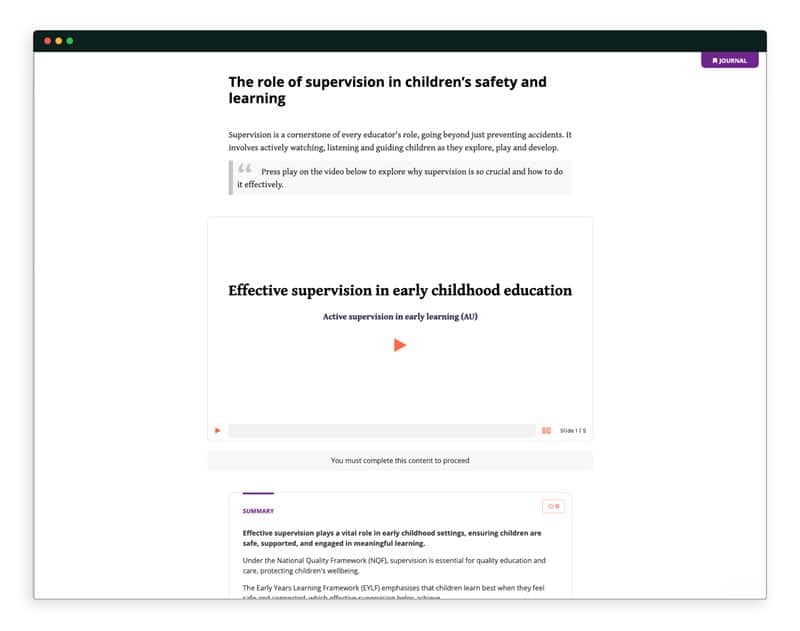
Topics Covered
- Understanding supervision under the NQF
- The principles of active supervision
- Applying active supervision in different settings
- Team-based supervision and communication
- Designing environments for supervision success

Course Experience
Learners can complete this course entirely online, at a time and pace that suits their shift patterns and service needs. The experience is designed specifically for busy early learning teams.
- Fully online and accessible anytime
- Interactive and scenario-based learning
- Self-paced completion (pause/resume anytime)
- Assessment: knowledge checks and reflection prompts (no formal quiz)
- Instant digital certificate on completion
- Accessible design (WCAG 2.2 compliant; suitable for a range of literacy levels)
Assessment
No formal scored assessment – instead, reflection points and knowledge checks are embedded throughout
Related Courses
- Duty of Care for Employees Training Course
- Allergy Awareness in Early Learning Training Course (AUS Version)
- Managing Medical Conditions in Early Childhood Services Training Course (AUS Version)
- WHS Fundamentals for Managers – AU Model Laws Training Course (AUS Version)
- Guiding Children’s Behaviours in Early Learning Training Course (AUS Version)
- General Evacuation Training Course (AUS Version)
- Warden Training 1: Emergency Preparation Training Course
- Warden Training 2: Emergency Response Training Course
- Safety for Children and Adults-at-Risk Training Course (AUS Version)

Learning Outcomes
By the end of this course, learners will be able to:
- Identify the key principles of active supervision in early learning environments
- Distinguish between “adequate” supervision and best-practice active supervision
- Apply practical supervision strategies across indoor, outdoor, routine and transition times
- Use communication and teamwork to ensure every child is consistently supervised
- Contribute to service-wide practices that support safety, wellbeing and quality under the NQF and NQS
Organisational Benefits
Implementing this training across your service or group of services can help you:
- Reduce the likelihood of incidents, injuries and near misses linked to supervision
- Demonstrate strong practice against relevant elements of the National Quality Standard
- Build consistent supervision expectations across permanent, part-time and casual staff
- Strengthen family confidence in the safety and quality of your service
- Provide clear evidence of supervision training for assessment, rating and regulatory visits

| Platforms | Desktop, laptop, tablet or mobile (widescreen) |
| Browsers | Chrome, Edge, Firefox and Safari are supported (typically versions from 2019 onwards). IE11 is not supported |
| Hosting | Enrol in Tribal Habits portal |
| Accessible | Yes, meets WCAG 2.2 guidelines at a Level AA standard – More info on WCAG 2.2 here |

Description
Why is the Active Supervision in Early Learning Course Important?
Supervision is one of the most critical responsibilities in early learning. When supervision is passive or inconsistent, the risk of injury, illness, behavioural incidents and complaints increases. Active supervision helps prevent accidents, supports children’s emotional security and builds families’ trust that their children are safe and well supported.
Under the Education and Care Services National Law and Regulations, and within the National Quality Framework (NQF) and National Quality Standard (NQS), services must ensure children are adequately supervised at all times. Understanding the difference between “adequate” and truly active supervision helps services meet their legal obligations and demonstrate high-quality practice in assessment and rating.
By building consistent supervision habits across the team, this course helps services reduce risk, support compliance and maintain safer learning environments.
Who Should Complete This Course
- Early childhood educators and assistants working directly with children in long day care, preschool or kindergarten
- Room leaders and lead educators are responsible for day-to-day supervision practices
- Educational leaders and supervisors support teams to improve supervision quality
- Casual, relief or new staff who need consistent expectations around supervision in your service
Topics Covered
Topics Covered
- Understanding supervision under the NQF
- The principles of active supervision
- Applying active supervision in different settings
- Team-based supervision and communication
- Designing environments for supervision success
Experience
Course Experience
Learners can complete this course entirely online, at a time and pace that suits their shift patterns and service needs. The experience is designed specifically for busy early learning teams.
- Fully online and accessible anytime
- Interactive and scenario-based learning
- Self-paced completion (pause/resume anytime)
- Assessment: knowledge checks and reflection prompts (no formal quiz)
- Instant digital certificate on completion
- Accessible design (WCAG 2.2 compliant; suitable for a range of literacy levels)
Assessment
No formal scored assessment – instead, reflection points and knowledge checks are embedded throughout
Related Courses
- Duty of Care for Employees Training Course
- Allergy Awareness in Early Learning Training Course (AUS Version)
- Managing Medical Conditions in Early Childhood Services Training Course (AUS Version)
- WHS Fundamentals for Managers – AU Model Laws Training Course (AUS Version)
- Guiding Children’s Behaviours in Early Learning Training Course (AUS Version)
- General Evacuation Training Course (AUS Version)
- Warden Training 1: Emergency Preparation Training Course
- Warden Training 2: Emergency Response Training Course
- Safety for Children and Adults-at-Risk Training Course (AUS Version)
Outcomes
Learning Outcomes
By the end of this course, learners will be able to:
- Identify the key principles of active supervision in early learning environments
- Distinguish between “adequate” supervision and best-practice active supervision
- Apply practical supervision strategies across indoor, outdoor, routine and transition times
- Use communication and teamwork to ensure every child is consistently supervised
- Contribute to service-wide practices that support safety, wellbeing and quality under the NQF and NQS
Organisational Benefits
Implementing this training across your service or group of services can help you:
- Reduce the likelihood of incidents, injuries and near misses linked to supervision
- Demonstrate strong practice against relevant elements of the National Quality Standard
- Build consistent supervision expectations across permanent, part-time and casual staff
- Strengthen family confidence in the safety and quality of your service
- Provide clear evidence of supervision training for assessment, rating and regulatory visits
Accessibility
| Platforms | Desktop, laptop, tablet or mobile (widescreen) |
| Browsers | Chrome, Edge, Firefox and Safari are supported (typically versions from 2019 onwards). IE11 is not supported |
| Hosting | Enrol in Tribal Habits portal |
| Accessible | Yes, meets WCAG 2.2 guidelines at a Level AA standard – More info on WCAG 2.2 here |